





Imagine hiring the smartest graduate from a top university. They have read every book in the library and memorised the dictionary. But when you ask them a specific question about your company’s internal leave policy, they simply guess.
This is the exact problem many enterprises face with Artificial Intelligence today. We have incredible AI models that can write poetry and code in seconds, but they struggle to give reliable, factual answers based on company data.
For a long time, businesses tried to fix this with basic search tools or complex “RAG” (Retrieval-Augmented Generation) pipelines. But these systems often break when you scale them up. They get confused by old documents, contradictory files, and permission settings.
Microsoft has shifted its focus. It’s no longer just about building bigger “AI models“. It is about building smarter “AI systems”.
In this guide, we will explain exactly what Microsoft Foundry IQ is, why it was built, and how it acts as the missing brain for your enterprise data.
What Is Microsoft Foundry IQ? (Plain-English Explanation)
Simply, Microsoft Foundry IQ is the intelligent layer that helps AI understand your business data, not just store it.
Think of your current data storage as a massive, disorganised library. Books are piled on the floor, some are outdated, and some are locked away. Standard search tools just scan the titles.
Foundry IQ acts as the master librarian. It reads the books, understands the context, checks which ones are up-to-date, knows who is allowed to read them, and then hands the exact right page to the AI agent.
It sits right in the middle of your architecture. On one side, you have your data (files, databases, intranets). On the other side, you have your AI (Copilots, agents, chatbots). Foundry IQ connects the two, turning raw data into “knowledge reasoning”.
It doesn’t just retrieve information; it understands whether that information is trustworthy and relevant before the AI ever speaks a word.
The Core Problem Foundry IQ Solves
To understand why Foundry IQ is such a game-changer, we first need to look at why previous attempts at “enterprise knowledge” have failed.
Why Traditional AI Knowledge Approaches Fail
Until now, most companies have relied on two things: standard keyword search or basic RAG pipelines. Both have major flaws.
- Search is shallow: If you search for “Project Alpha”, a standard search engine gives you every document with those words. It doesn’t know that the project was cancelled six months ago.
- RAG breaks at scale: Building a custom Retrieval-Augmented Generation system is easy for a demo, but hard for a real company. It struggles to handle thousands of documents and often retrieves conflicting information.
- No understanding of authority: Most systems treat a random draft email the same way they treat a signed PDF policy document. This leads to AI “hallucinations” (wrong answers).
Why AI Agents Need a New Knowledge Model
As we move into the era of AI Agents—software that can take action on your behalf—accuracy is non-negotiable. An agent cannot just guess; it must know.
Agents need to:
- Ask the right clarifying questions.
- Choose trusted sources over untrusted ones.
- Reason across different systems (e.g., comparing a PDF invoice to a database entry).
Foundry IQ provides “decision-grade knowledge”. It gives agents the confidence to act, knowing the information they are using is correct.
How Microsoft Foundry IQ Works (Conceptual Architecture)
You don’t need to be a software engineer to understand how this works. Here is the simple mental model of the process:
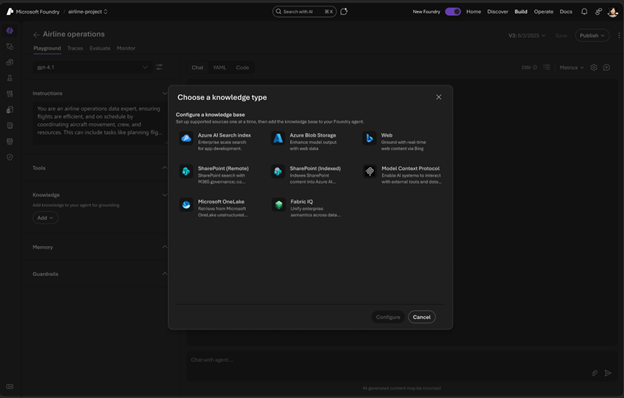
- Knowledge Ingestion: First, Foundry IQ connects to your data sources—SharePoint, SQL databases, internal wikis, and more.
- Normalisation and Understanding: It cleans up the data. It strips away the mess and figures out what the information actually means (semantic understanding), rather than just looking at keywords.
- The Knowledge Graph: It builds a map of your data. It links concepts together. It understands that “Project X” is related to “Department Y”.
- Continuous Checks: It constantly monitors for changes. If a document is updated, Foundry IQ knows immediately. It also checks authority (is this an official doc?) and context.
- Secure Delivery: Finally, it delivers this polished, verified knowledge to your AI agents and Copilots securely.
Key Capabilities of Microsoft Foundry IQ
If you are evaluating this tool for your business, here are the headline features you need to know:
- Multi-source knowledge unification: It pulls data from everywhere into one logical place without moving the actual files.
- Semantic understanding: It understands intent. If you ask for “holiday rules”, it knows to look for “annual leave policy”.
- Authority and trust scoring: It ranks information based on how trustworthy the source is.
- Real-time freshness awareness: It prioritises the newest version of a document.
- Enterprise-grade security: It respects all existing permissions. If a user can’t see a file, the AI won’t show it to them.
- Native integration: It is built to plug directly into AI agents.
Foundry IQ vs Traditional RAG vs Search
It can be confusing to differentiate between these technologies. Here is a quick comparison to help you spot the differences.
| Capability | Traditional Search | RAG Pipelines | Microsoft Foundry IQ |
|---|---|---|---|
| Context awareness | Low | Medium | High |
| Knowledge freshness | Manual | Fragile | Continuous |
| Trust & authority | None | None | Built-in |
| Enterprise scale | Limited | Complex | Native |
| Agent readiness | ❌ | ⚠️ | ✅ |
Foundry IQ’s Role in Agentic AI
This is perhaps the most critical section for 2026. We are moving away from simple chatbots that just talk, towards “Agentic AI“—systems that do things.
Think of Foundry IQ as the brain’s memory system. Without a good memory, an agent is useless. Foundry IQ enables agents to decide:
- What to answer: based on facts, not creative writing.
- Where to look: narrowing down the search to relevant departments.
- What NOT to use: ignoring drafts, outdated files, or sensitive data.
This distinction is vital. A Chatbot chats. A Copilot assists you alongside your work. A True AI Agent works autonomously to solve problems. Foundry IQ is the safety rail that allows that autonomy to happen safely.
Real-World Enterprise Use Cases
Where does this actually fit into your business?
AI Agents for Internal Knowledge
Imagine an HR policy assistant. Instead of employees emailing HR, they ask the agent. Foundry IQ ensures the agent ignores the old 2023 policy document and only answers based on the signed 2026 PDF. It saves the HR team hours of repetitive work.
AI for Decision Support
Executives often need to query trusted insights. A Finance Copilot powered by Foundry IQ can reason across spreadsheets and policy docs to tell a CFO if a specific expense is compliant with new regulations.
AI for Customer-Facing Scenarios
For customer support, accuracy is everything. Foundry IQ helps support bots provide precise answers about contracts or warranties, drastically reducing the risk of the AI making up a policy that doesn’t exist.
Security, Governance, and Trust (Enterprise Readiness)
For regulated industries like finance, healthcare, or legal, security is the biggest barrier to AI adoption.
Foundry IQ addresses this head-on:
- Permissions are respected end-to-end: The system inherits the Access Control Lists (ACLs) from your data sources.
- No model training: Microsoft does not use your tenant data to train their base models. Your secrets remain yours.
- Auditability: You can see exactly which document the AI used to generate an answer. This “explainability” is crucial for compliance.
Foundry IQ vs Other Knowledge Platforms
Why use this instead of a vector database or a third-party tool?
- Vs Vector Databases: A vector database is just storage for numbers. It doesn’t have the logic, the security inheritance, or the semantic reasoning built-in. You have to build all that yourself.
- Vs Custom RAG Frameworks: Custom frameworks require massive engineering overhead to maintain. Foundry IQ is a managed service—Microsoft handles the plumbing.
- Vs Third-party AI Search: Native integration matters. Because Foundry IQ lives inside Azure, it works seamlessly with the rest of your Microsoft stack without complex connectors.
How Foundry IQ Fits into the Microsoft AI Stack
It helps to visualise where this sits. Foundry IQ is the backbone.
- Azure AI Foundry is the workshop where you build the apps.
- Azure OpenAI provides the language models (the engine).
- Microsoft Fabric handles the data analytics.
- Foundry IQ provides the intelligence and context to connect them all.
It isn’t “just another tool”; it is the glue that makes the other tools enterprise-ready.
Business Impact & ROI
Implementing Foundry IQ isn’t just a technical decision; it’s a business one.
- Reduced hallucinations: Less time spent checking if the AI is lying.
- Faster AI adoption: You can deploy agents in weeks, not months, because the “knowledge layer” is already solved.
- Lower engineering overhead: Your developers stop building custom RAG pipelines and start building business value.
- Higher trust: When employees trust the tool, they actually use it.
Who Should Use Microsoft Foundry IQ?
This solution is ideal for:
- Large enterprises with vast, messy data estates.
- Regulated industries that cannot afford AI mistakes.
- Organizations building AI agents that need to take action.
- Teams scaling Copilot who find the out-of-the-box answers aren’t specific enough.
How Empathy Technologies Helps with Foundry IQ
Navigating the world of Enterprise AI can be daunting. At Empathy Technologies, we specialise in turning these complex tools into practical business results.
We help organisations with:
- Readiness assessments: Is your data ready for Foundry IQ?
- Knowledge architecture: Designing the logic of how your AI should think.
- Integration: seamless connection between Foundry IQ, your custom agents, and Microsoft Copilot.
- Governance: Ensuring your security protocols are tight.
FAQ – Microsoft Foundry IQ
Is Microsoft Foundry IQ a database?
No. It is a knowledge intelligence layer that sits on top of your existing databases and files to help AI understand them.
How is Foundry IQ different from RAG?
RAG is a technique; Foundry IQ is a managed platform that executes RAG at an enterprise scale, handling security, freshness, and authority automatically.
Does Foundry IQ replace search?
No, it enhances it. It powers the “semantic” search capabilities that allow agents to find answers based on meaning, not just keywords.
Is Foundry IQ required for AI agents?
Technically no, but practically yes. Without a system like Foundry IQ, agents lack the reliable context needed to work autonomously without errors.
Who should implement Foundry IQ first?
IT and Data teams responsible for enabling AI across the business should prioritise this as a foundational step.
Conclusion – Foundry IQ Is the Missing Layer in Enterprise AI
We have spent the last few years marvelling at how powerful AI models are. But models alone are not enough. Data is everywhere, yet trusted knowledge has remained the real bottleneck.
Microsoft Foundry IQ solves what AI alone cannot. It bridges the gap between raw data and intelligent action, providing the trusted foundation required for the next generation of business.
If you are ready to move beyond basic chatbots and build true, decision-grade AI agents, the time to sort your knowledge layer is now.
👉 Talk to Empathy Technologies to design a trusted AI knowledge foundation with Microsoft Foundry IQ
Good post! We will be linking to this particularly great post on our site. Keep up the great writing